 Mezo
Mezo liquidity pools combine swap fees with changing token exposure
Updated ·
Mezo liquidity pools can generate fees that offset impermanent loss, although the outcome depends on trading volume and relative token prices. Your share of those fees also depends on pool type and staking status. BTC gas costs reduce the return, so compare withdrawn assets and actual rewards with holding the same tokens.
An Unstaked Basic Position With a Clear Exit
An unstaked basic pool exit on Mezo Mainnet needs liquidity provider (LP) tokens in the wallet and BTC for transaction fees. A position already staked in a gauge needs unstaking before liquidity removal.
- The holding represents a basic pool position through ERC-20 LP tokens.
- The LP tokens needed for the withdrawal are unstaked and available in the wallet.
- BTC remains outside the position to pay for the required exit transactions.
- You're willing to receive both tokens in the pool's current proportions.
- The return comparison includes accrued fees separately from the underlying reserves.
Removing liquidity burns the selected LP tokens and returns the corresponding share of underlying assets. Completion means those assets have reached the wallet. Unstaking alone returns LP tokens and stops their emission income; the liquidity remains in the pool until removal. The exit cost depends on required transactions and their gas charges.
If you need exactly the original token quantities back, intervening trades can leave you with different amounts.
Pool Reserves, LP Shares and Gauge Rewards
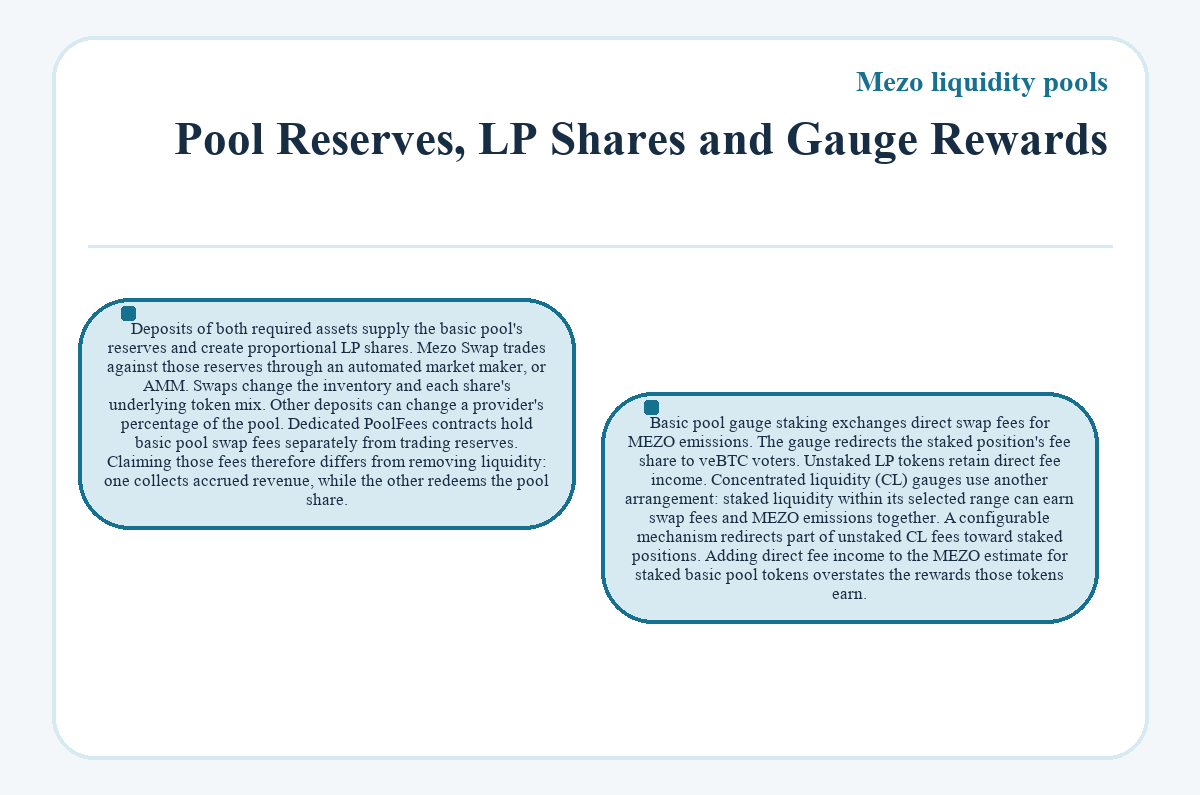
Deposits of both required assets supply the basic pool's reserves and create proportional LP shares. Mezo Swap trades against those reserves through an automated market maker, or AMM. Swaps change the inventory and each share's underlying token mix. Other deposits can change a provider's percentage of the pool. Dedicated PoolFees contracts hold basic pool swap fees separately from trading reserves. Claiming those fees therefore differs from removing liquidity: one collects accrued revenue, while the other redeems the pool share.
Basic pool gauge staking exchanges direct swap fees for MEZO emissions. The gauge redirects the staked position's fee share to veBTC voters. Unstaked LP tokens retain direct fee income. Concentrated liquidity (CL) gauges use another arrangement: staked liquidity within its selected range can earn swap fees and MEZO emissions together. A configurable mechanism redirects part of unstaked CL fees toward staked positions. Adding direct fee income to the MEZO estimate for staked basic pool tokens overstates the rewards those tokens earn.
When Can Fees Cover Impermanent Loss?
Fees offset impermanent loss when eligible fee income covers the shortfall against holding the deposited tokens. The comparison needs the same valuation time on both sides. Count withdrawable assets, add only rewards the position actually earns and subtract gas and conversion costs. Compare that total with the current value of the original token quantities held outside the pool.
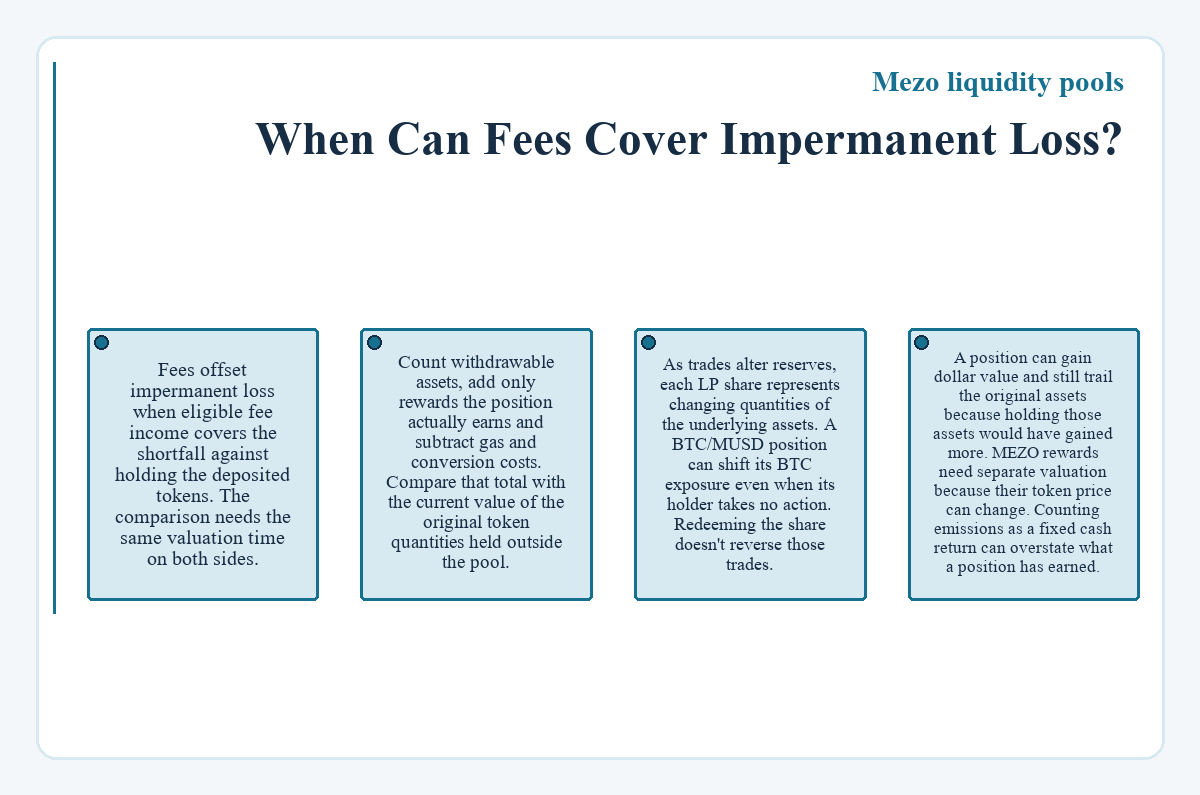
As trades alter reserves, each LP share represents changing quantities of the underlying assets. A BTC/MUSD position can shift its BTC exposure even when its holder takes no action. Redeeming the share doesn't reverse those trades. A position can gain dollar value and still trail the original assets because holding those assets would have gained more.
MEZO rewards need separate valuation because their token price can change. Counting emissions as a fixed cash return can overstate what a position has earned.
Which Pool Structure Fits Your Token Exposure?
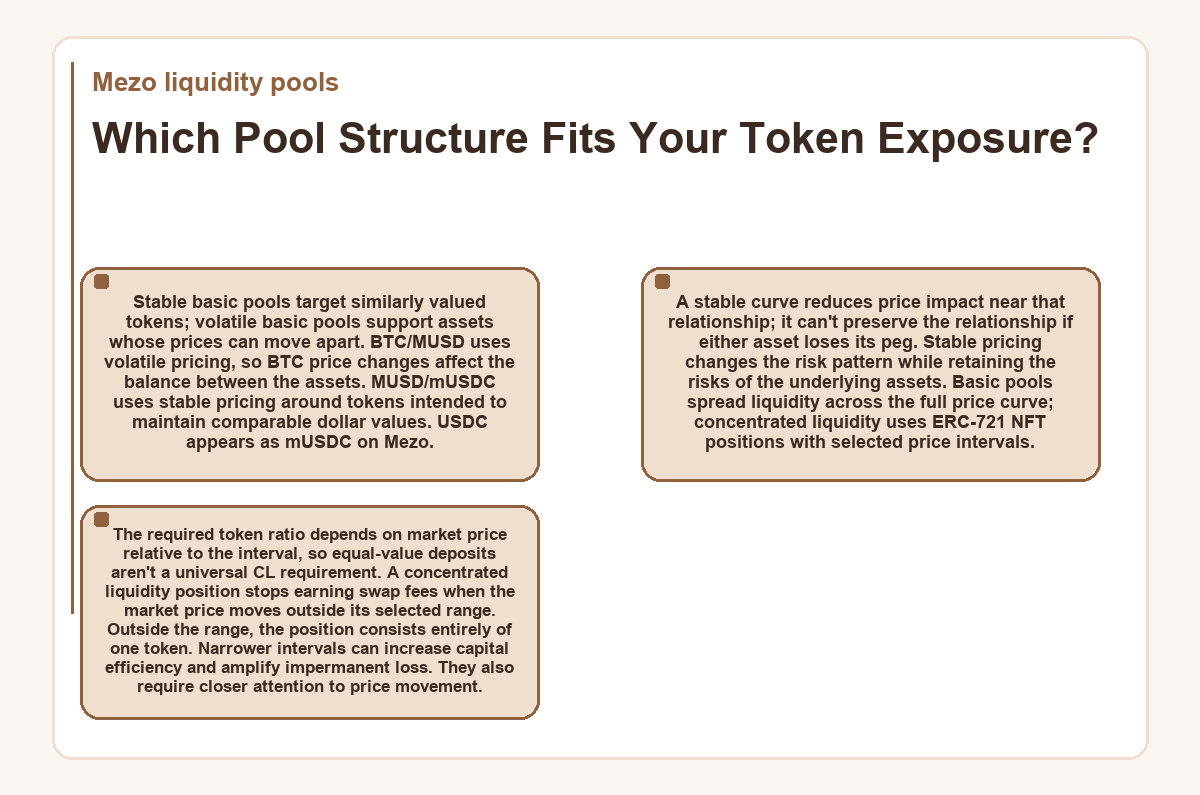
Stable basic pools target similarly valued tokens; volatile basic pools support assets whose prices can move apart. BTC/MUSD uses volatile pricing, so BTC price changes affect the balance between the assets. MUSD/mUSDC uses stable pricing around tokens intended to maintain comparable dollar values. USDC appears as mUSDC on Mezo. A stable curve reduces price impact near that relationship; it can't preserve the relationship if either asset loses its peg. Stable pricing changes the risk pattern while retaining the risks of the underlying assets.
Basic pools spread liquidity across the full price curve; concentrated liquidity uses ERC-721 NFT positions with selected price intervals. The required token ratio depends on market price relative to the interval, so equal-value deposits aren't a universal CL requirement. A concentrated liquidity position stops earning swap fees when the market price moves outside its selected range. Outside the range, the position consists entirely of one token. Narrower intervals can increase capital efficiency and amplify impermanent loss. They also require closer attention to price movement.
Swap Charges, Trading Activity and BTC Gas
Standard basic pool swap fees are 0.30% for volatile pairs and 0.02% for stable pairs. These percentages apply to the token sold in each swap. Governance can set custom basic pool rates, so the selected pool's charge can differ. CL pools have separate tick-spacing defaults and configurable fee modules. The BTC/MUSD-200 CL pool has tick spacing of 200 and a default swap fee of 0.30%. A quoted trading charge helps estimate revenue per trade; total value locked measures deposited capital and doesn't establish the income an individual position earns.
Trading volume and eligible liquidity share determine gross fee income over the period measured. Concentrated positions participate only in trading within their selected ranges. More competing liquidity can reduce a position's share even if trading activity stays unchanged.
BTC pays Mezo transaction fees for actions including claims and liquidity removal. Ethereum-side bridge transactions require ETH gas. Repeated claims or range changes can create additional transaction costs, so a smaller position may spend a larger fraction of its rewards on transactions. For new funding, tBTC deposited from Ethereum through an EVM wallet arrives as BTC on Mezo. Native BTC bridge-ins closed on October 13, 2026; direct bridge-outs remain available.
Pool Exposure Versus Vault Yield
Single-asset vaults seek yield without putting a holder directly into a two-token AMM position. The MUSD Savings Vault accepts MUSD; the USDC Lending Vault supplies mUSDC to a BTC-backed lending market. Their receipt tokens represent vault claims. Vault strategies carry contract and strategy risks. Pool contracts also carry exploit risk separate from impermanent loss, even after an audit. In the lending vault, high utilization can block a full mUSDC withdrawal until borrowers repay or new supply arrives.
Mezo liquidity pools: questions and answers
Do Basic Pool Fees Compound Automatically?
Swap fees earned by unstaked basic pool LP tokens don't compound automatically. They accumulate separately and need to be claimed and redeposited to increase liquidity. Reinvestment can add BTC transaction costs, so those charges reduce how much of the claimed revenue becomes new liquidity.
Why Can I Claim Fees in Both Tokens of a Pair?
An unstaked basic pool LP can accrue fees in both tokens because each swap charges the asset sold. Trades in opposite directions produce fees in different assets. The accrued quantities depend on actual volume and direction; they aren't necessarily equal or automatically converted into a single reward token.
Is Holding MEZO Required to Provide Pool Liquidity?
MEZO isn't a separate prerequisite for providing basic pool liquidity. The required holdings are the selected pool's assets and BTC for Mezo transaction fees. Receiving MEZO emissions through eligible gauge staking is a different activity from locking MEZO into veMEZO, which belongs to the network's voting and boost system.
When Does a Pool's MEZO Emission Allocation Change?
Basic pool gauge emission allocations follow Mezo Earn's seven-day epochs. Votes cast during one epoch determine the following epoch's allocation. Each epoch begins Thursday at 00:00 UTC. A pool's emission income can therefore change with vote allocation, so its current reward rate isn't a fixed return for an LP position.
Which Tokens Can Fund Get Gas for a Pool Withdrawal?
Get Gas accepts MUSD or MEZO for a gasless BTC top-up. The button appears when the wallet's BTC balance falls below 0.000001 BTC. The swap exchanges a variable amount of the selected token for 0.0001 BTC. The relay covers the top-up transaction's gas; liquidity removal still requires BTC.
Why Can a Swap Revert Despite Available Pool Liquidity?
A Mezo Swap transaction can revert when execution moves beyond its permitted slippage. Other trades can change pool prices before the transaction executes, and limited liquidity increases price impact. Available reserves therefore don't guarantee the quoted output. Slippage is an execution constraint, separate from the fee charged on a successful swap.
Are Mainnet and Testnet LP Tokens Interchangeable?
Mezo Mainnet and Testnet LP tokens belong to separate networks and pool contracts. A test position doesn't represent deposited Mainnet assets or a claim on Mainnet pool fees. Matching token names don't merge those balances, so the wallet's active network matters when viewing a position or preparing a transaction.
Does Providing Liquidity Repay an MUSD Loan?
Providing liquidity doesn't repay an MUSD loan. MUSD borrowed against BTC remains a separate obligation with interest and collateral requirements, even when the proceeds enter a pool. Borrowing costs reduce the funded position's net return alongside impermanent loss and transaction charges.