 Mezo
Mezo gives BTC holders voting power through veBTC locks
Updated ·
Mezo gives BTC holders voting power over MEZO emissions when they lock BTC into veBTC positions. Each position has an NFT, and its voting weight declines as the lock approaches expiry. veMEZO can amplify that weight, while gauges connect votes with specific pools and other reward destinations.
BTC Amount and Remaining Lock Time
BTC amount and remaining lock time determine base veBTC weight. More locked BTC produces more weight at the same remaining duration. A longer remaining lock sustains that weight for longer. veBTC means vote-escrowed BTC; its non-fungible token, or NFT, represents the locked position. Voting weight declines linearly as a veBTC lock approaches expiry. The BTC amount and current vote weight describe different properties. The first records committed assets; the second records the position's changing influence.
BTC can't be unlocked early. Extending a lock maintains voting power while moving the date the BTC becomes available.
How Do Gauge Votes Direct MEZO Emissions?
veBTC votes direct MEZO emissions by allocating voting weight to gauges, which are contracts attached to reward destinations. Staking gauges connect those allocations with liquidity pools and the MUSD Savings Vault. They distribute emissions to stakers and eligible revenue to voters.
A gauge's share of allocated voting weight determines its share of emissions within that branch. A holder's share of votes at that gauge determines their share of its eligible voter rewards. These are different denominators: gauges compete with other destinations, while each voter shares a gauge's revenue with its other voters.
Weekly epochs separate the voting period from the emission allocation it determines. Each epoch lasts seven days and starts Thursday at 00:00 UTC. Votes recorded during one epoch determine the following epoch's emissions. Gauge fees generated during an epoch follow that epoch's vote allocations.
veMEZO Boosts and the Matching Market
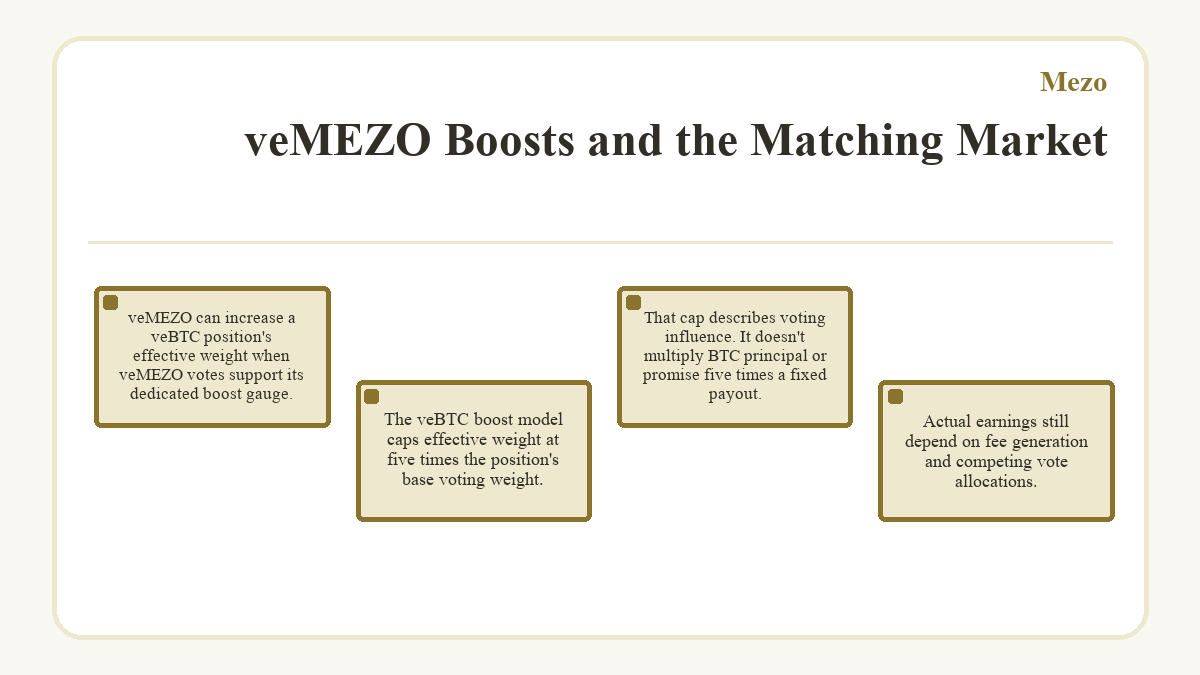
veMEZO can increase a veBTC position's effective weight when veMEZO votes support its dedicated boost gauge. The veBTC boost model caps effective weight at five times the position's base voting weight. That cap describes voting influence. It doesn't multiply BTC principal or promise five times a fixed payout. Actual earnings still depend on fee generation and competing vote allocations.
Relative Shares
Boost depends on a position's share of total veBTC and the share of total veMEZO allocated to it. A larger share of total veBTC needs proportionally more veMEZO support to maintain the same multiplier. Other positions can change those relative shares even if a holder changes neither lock. veMEZO weight also varies with its own lock duration.
Sources of Boost
Self-Directed veMEZO
A holder may direct their own veMEZO toward their veBTC position's boost gauge. The MEZO lock supplies support to the BTC lock, while the BTC lock remains the basis for staking-gauge voting. Holding liquid MEZO alone doesn't perform that allocation.
Votes From Other Holders
The matching market lets a veBTC holder post incentives to attract veMEZO votes from other wallets. Those votes can support the BTC position without its owner buying and locking MEZO. Incentive payments go to the supporting veMEZO voters. Posting an incentive doesn't guarantee enough votes to reach the cap. Changes to boost need a voting-power refresh. During pairing, the Pair & Boost interface updates the position and refreshes existing votes automatically.
Token Holdings and Voting Rights
The asset held and the lock created determine voting rights. veBTC supplies the direct input for staking-gauge allocations. veMEZO also has destinations that don't require a veBTC holding: boost gauges and MEZO Gauges. These are separate from a staking-gauge vote, so its lack of standalone staking weight doesn't remove those rights.
| Holding or Position | Voting Rights and Limits |
|---|---|
| Unlocked BTC on Mezo | No veBTC voting weight until the BTC is locked. |
| Active Unboosted veBTC | Can vote on staking gauges at its time-dependent base weight. |
| Active veBTC With veMEZO Support | Uses boosted staking-gauge weight after a voting-power refresh; support must reach its dedicated boost gauge. |
| Liquid MEZO | Can be held or traded; veMEZO voting rights require locked MEZO. |
| veMEZO Without veBTC | Can vote on boost gauges and MEZO Gauges; can't independently vote on staking gauges. |
| veMEZO With veBTC | Can boost its own active BTC lock and separately vote on MEZO Gauges. |
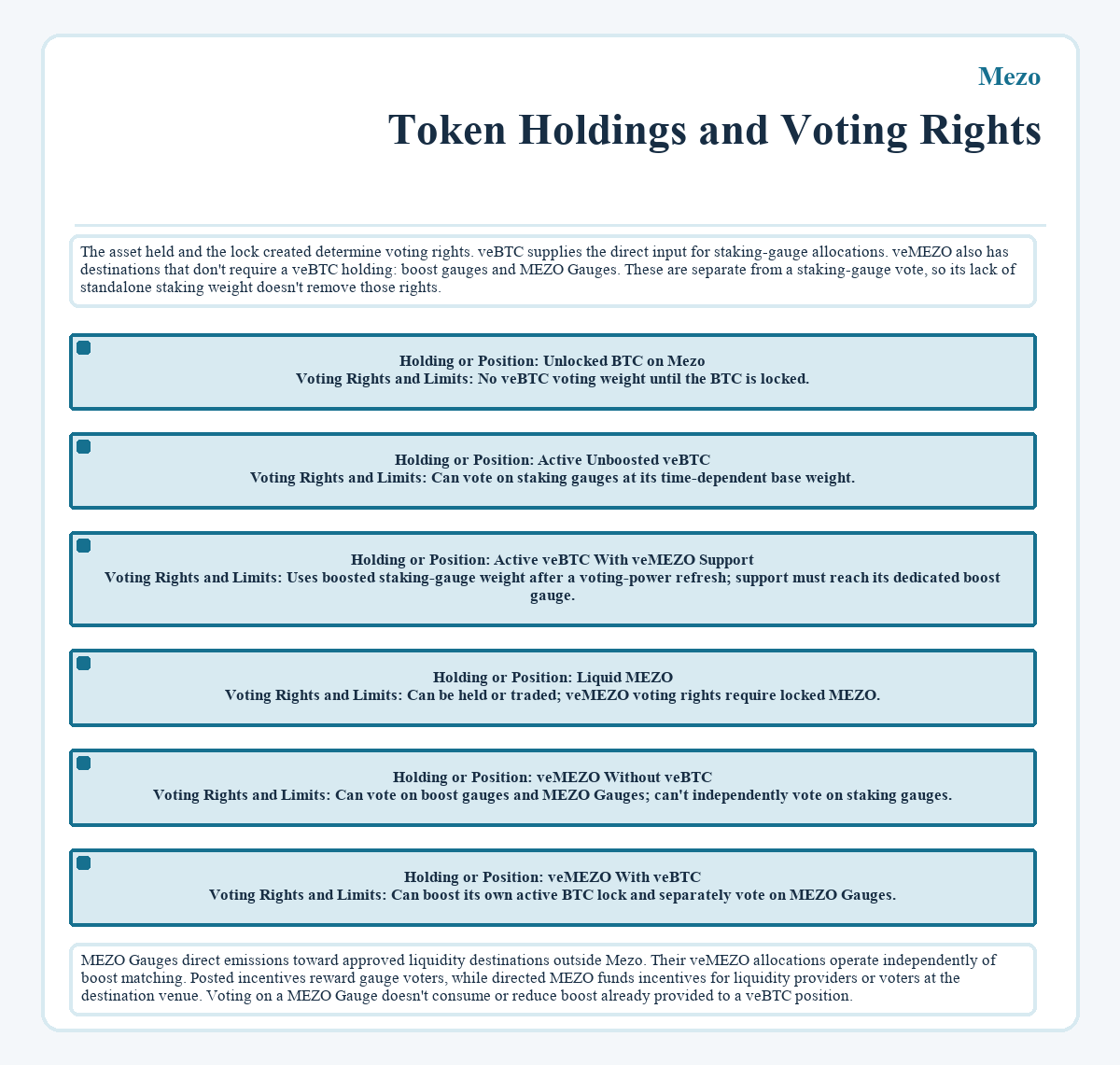
MEZO Gauges direct emissions toward approved liquidity destinations outside Mezo. Their veMEZO allocations operate independently of boost matching. Posted incentives reward gauge voters, while directed MEZO funds incentives for liquidity providers or voters at the destination venue. Voting on a MEZO Gauge doesn't consume or reduce boost already provided to a veBTC position.
Which Earnings Require a veBTC Vote?
veBTC holders need votes to earn a gauge's eligible fees and posted incentives; chain and bridging fees accrue without an allocation. A vote receives a proportional share of eligible rewards, so earnings depend on activity and the weight competing for that gauge. Incentives add a separate reward only when someone has funded them. Emissions distribute MEZO, while trading fees come from swaps.
Passive Chain Revenue
veBTC holders share chain and bridging fees without casting gauge votes. Each position's boosted weight determines its share. This income varies with network activity and other eligible positions, so the amount of BTC locked doesn't establish a fixed interest rate.
Revenue From Staked Positions
The USDC Lending Vault shows how staking can redirect revenue toward veBTC voters. Holding its morphoBTC-mUSDC shares earns borrower interest. Staking those shares instead earns MEZO emissions and sends the associated interest to voters on the Lending Vault gauge. A single share can't earn both streams simultaneously. Holdings can be split between those states.
Lock Expiry and Network Funding
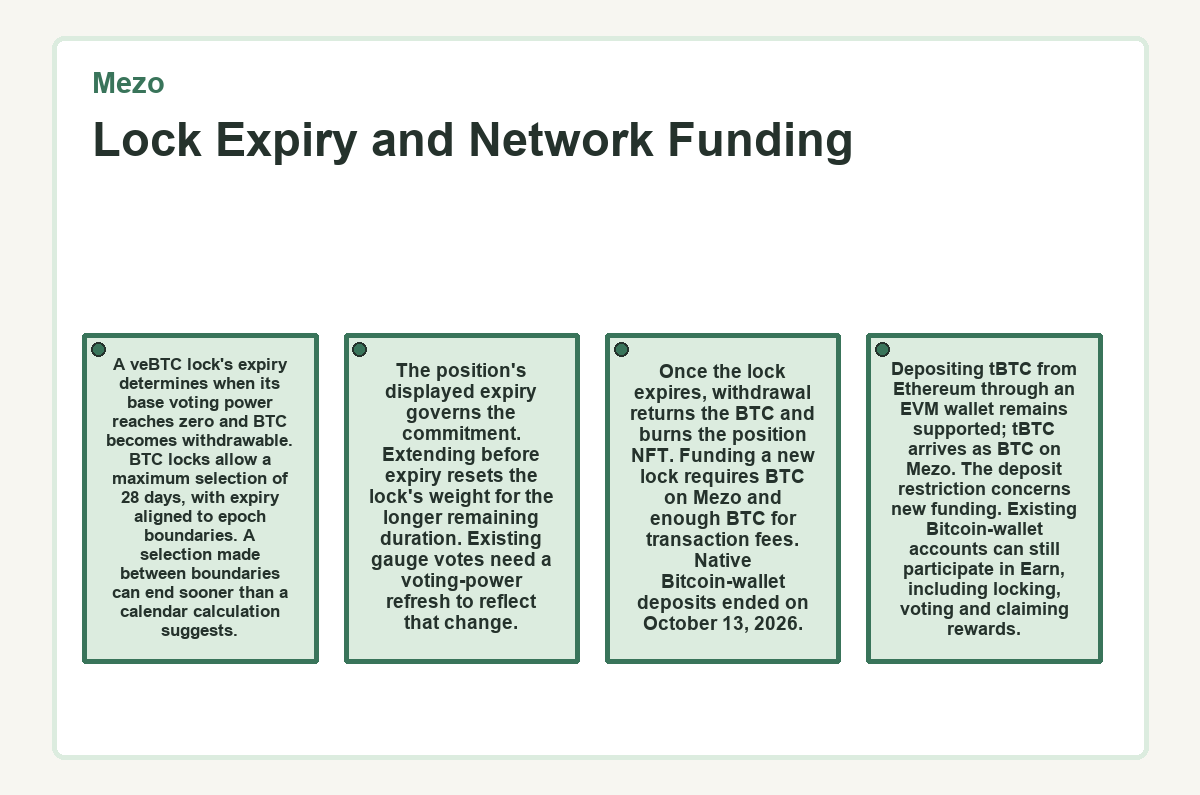
A veBTC lock's expiry determines when its base voting power reaches zero and BTC becomes withdrawable. BTC locks allow a maximum selection of 28 days, with expiry aligned to epoch boundaries. A selection made between boundaries can end sooner than a calendar calculation suggests. The position's displayed expiry governs the commitment. Extending before expiry resets the lock's weight for the longer remaining duration. Existing gauge votes need a voting-power refresh to reflect that change. Once the lock expires, withdrawal returns the BTC and burns the position NFT.
Funding a new lock requires BTC on Mezo and enough BTC for transaction fees. Native Bitcoin-wallet deposits ended on October 13, 2026. Depositing tBTC from Ethereum through an EVM wallet remains supported; tBTC arrives as BTC on Mezo. The deposit restriction concerns new funding. Existing Bitcoin-wallet accounts can still participate in Earn, including locking, voting and claiming rewards.
What readers ask about Mezo
Does Locking BTC Also Make It Available for an MUSD Loan?
BTC committed to a veBTC lock isn't available as collateral in the MUSD borrowing system until the underlying BTC is unlocked. The NFT represents an Earn position; it doesn't replace BTC collateral for a borrowing position. A borrowing plan must account for the lock's expiry because veBTC locks don't permit early unlocking.
Are veMEZO Lock Positions Transferable?
veMEZO positions are transferable ERC-721 NFTs. Each position represents locked MEZO, and positions can also be merged. Transferring the NFT doesn't unlock its underlying MEZO. The NFT's transferability doesn't give a recipient standalone staking-gauge voting power, which still requires veBTC.
What Does a veMEZO Rebase Reward Represent?
A veMEZO rebase is an anti-dilution distribution drawn from MEZO emissions. It's separate from the incentives veBTC holders post to attract boost votes. Rebases concern the locked MEZO position; they don't represent the chain and bridging revenue allocated to veBTC holders or establish a fixed BTC-denominated return.
When Do Fees Earned Through veBTC Votes Become Claimable?
Fees and incentives earned through veBTC votes become claimable after the epoch earning them has ended. Amounts shown during an active epoch are estimates of accruing rewards. Claiming doesn't automatically reinvest rewards or extend the BTC lock. The reward claim period and the expiry date controlling withdrawal of locked BTC are separate. Passive chain fees remain claimable for 50 epochs; unclaimed fees are then lost.
Can One Wallet Hold Several veBTC Locks?
A wallet can hold multiple veBTC positions, with a separate NFT for each lock. Each position has its own voting power and dedicated boost gauge. The positions remain distinct even when one wallet holds them, and the protocol also supports merging them.
Which Tokens Are Paid to veBTC Gauge Voters?
veBTC gauge voters receive the tokens generated as fees or supplied as incentives for the gauges they support. The voting asset doesn't determine a single payout currency. Pool trading can produce fees in either asset of its pair, and a posted incentive has its own token. These rewards differ from the MEZO emissions allocated to stakers.